

What the Zarubina investigation reveals about Russia’s international operations
 Read NV on Google

Nomma Zarubina at a public event (Photo: Nomma Zarubina / Facebook)
On Dec. 3, the Organized Crime and Corruption Reporting Project (OCCRP) reported that a New York district court had revoked the bail of Russian citizen Nomma Zarubina, who had earlier been charged, among other counts, with working for Russian intelligence. Following an emergency hearing, the court ordered her taken into custody. NV English obtained additional documents related to Zarubina’s case that expose an extensive global network of Russian espionage and influence operations — evidence that the Kremlin is building a civilian ecosystem to shape international narratives.
The decision to jail Zarubina was made after she continued to harass the FBI agent handling her case, despite a judge’s warning, while she remained out on bond.
According to the United Front of Resistance (UFR), a clandestine global anti-Kremlin organization, its volunteers conducted an operation targeting Nomma Zarubina, a 36-year-old Russian citizen who at the time was awaiting court hearings in the United States on multiple charges.The group says it has remotely transferred all information obtained during the operation to Ukraine’s Security Service (SBU).
The United Front also suggests that Sarah Ashton-Cirillo’s visit to Zarubina in New York in June 2025 — a meeting publicly documented on X — played a significant role in enabling the operation. At the time, Ashton-Cirillo was an official volunteer representing Ukraine’s foreign recruitment efforts.
When New Voice contacted her after Zarubina’s arrest, Ashton-Cirillo confirmed the authenticity of the materials, provided the newsroom with additional photos and screenshots, and confirmed that she was the author of the leaked documents. She is currently serving combat duties as a sergeant in the Ukrainian Armed Forces with a unit in eastern Ukraine.

According to her Facebook page, Nomma Zarubina was born in Tomsk, in Siberia. She studied international relations and national security at the Russian Presidential Academy of National Economy and Public Administration (RANEPA) and at Saint Petersburg State University.
After receiving what is considered an elite education in Russia, Zarubina began traveling extensively after 2011, maintaining a visible public profile and regularly appearing as a speaker and expert at international conferences — including events organized by the Russian opposition in exile. In the mid-2010s, after completing her master’s degree at RANEPA, she moved to the United States, where she enrolled in a second master’s program at Baruch College. In 2018–2019, Zarubina met and became close with Elena Branson — a dual U.S.-Russian citizen who was charged in 2022 with acting as an unregistered foreign agent.
By the time the charges were filed, Branson had already fled the United States. She founded the “Russian Center New York” and oversaw the “I Love Russia” campaign, which prosecutors described as a Kremlin-funded propaganda initiative. Branson’s case remains open.
In December 2024, the U.S. Department of Justice charged Zarubina — who was living in New York — with making false statements to FBI agents about her ties to the FSB. According to the complaint, Zarubina was recruited by the FSB in 2020 under the codename “Alyssa” and used to establish contacts with American journalists, military analysts, and think-tank experts. Prosecutors allege that she attended forums in the United States and Europe to promote Kremlin narratives. She was arrested on Nov. 21, 2024, and released on a $25,000 bond under several restrictions: surrendering her passport, remaining in New York, and avoiding contact with Russian officials. Although Zarubina denied formally working for the FSB, the FBI complaint notes that during a 2023 interview she admitted to lying about her contacts.
According to Zarubina, who contacted the NV English newsroom after the Dec. 2 publication, she has been cooperating with the FBI in this case since 2021. “Despite the fact that the agents received all the information from me, they still chose to bring charges at the end of 2024,” she said.
Among the documents obtained by NV are scans of Nomma Zarubina’s correspondence with her handlers — 36-year-old FSB Lieutenant Colonel Roman Sumarokov and 35-year-old Kirill Frolov from Tomsk.


In these exchanges, Sumarokov, among other things, boasts about his newly awarded military rank, and in another message sends her a nude photo of himself.


In a separate exchange, another unidentified Russian intelligence officer tries to console Zarubina as she complains to him about feeling depressed.

The photos also offer a glimpse into the everyday life of the Russian agent — her trips to baseball games wearing Ukrainian symbols, her studies at prestigious academic institutions, and her literary tastes.
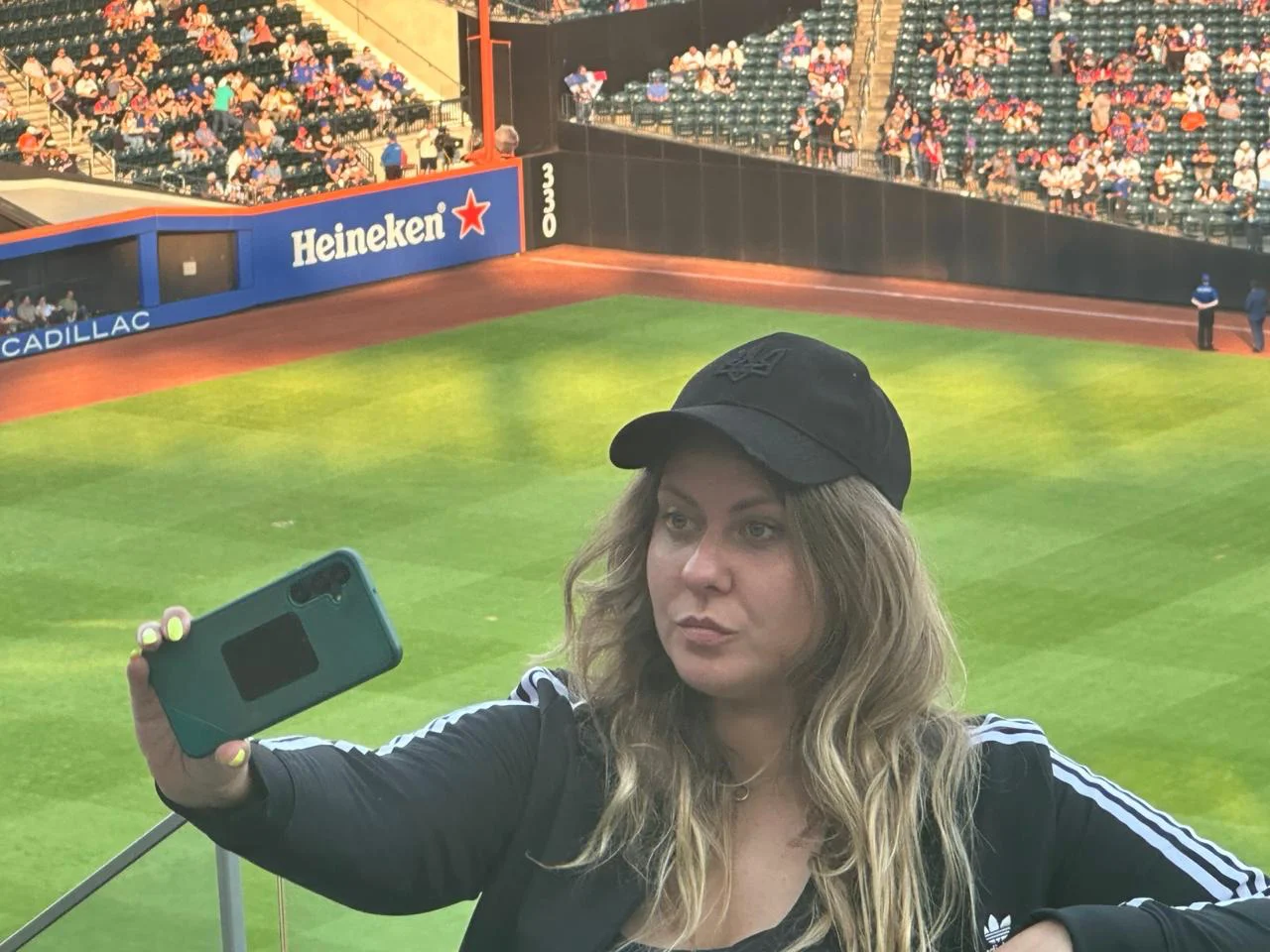


It is noteworthy that shortly before the court hearing that resulted in her being taken into custody, Zarubina attempted to arrange a meeting with a retired U.S. Army brigadier general who had served as a defense attaché at the U.S. Embassy in Russia.

Inside Russia’s global soft-power spy ring
Documents obtained by NV English reveal an extensive, multi-layered influence-and-recruitment ecosystem run by Russian security services that reaches across Europe, Africa, Asia, North America, and the Middle East. At the center of this system is a familiar pattern: public-facing “youth diplomacy,” cultural outreach, and civil-society networks masking covert intelligence collection, talent-spotting, and narrative penetration.


Zarubina's case provides an unusually detailed window into how that machine functions. It shows how Russian intelligence embeds itself within global social networks, uses state-sponsored conferences as recruitment venues, and merges diaspora outreach with covert operations.
A recruitment hub disguised as a youth network
A consistent hub in Zarubina’s network was Roman Chukov, a senior Kremlin-connected youth policy official and co-founder of Friends for Leadership (FFL). According to the documents, Chukov chaired the Ruspromo Foundation and previously served as Assistant Director for Youth Policy at the Roscongress Foundation — the Kremlin entity that runs the annual St. Petersburg International Economic Forum (SPIEF). His programs, including FFL and international youth panels at SPIEF, served as “recruitment pipelines” connecting Russian officials with dozens of foreign participants.
Through Chukov, Zarubina gained access to an international roster of young politicians, media figures, social entrepreneurs, and academics — many of whom appeared repeatedly across Russian-backed events: SPIEF youth forums, Russia–Africa congresses, Valdai-affiliated policy discussions, BRICS research groups, and even the Davos “Russian House” in 2020.
These were not coincidental gatherings. Investigators concluded that the same individuals resurfaced across platforms because the events were woven into a single, state-directed ecosystem aimed at cultivating future interlocutors sympathetic (or useful) to Moscow’s geopolitical messaging.
Multiple Russian operatives guiding her work
The documents make clear that Zarubina’s activities in the United States were not independent freelancing. She was recruited by the FSB in 2020, given the codename “Alyssa,” and tasked with identifying journalists, think-tank professionals, and community leaders who might be suitable for eventual recruitment.
Her handlers included at least one FSB lieutenant colonel responsible for counterintelligence related to Russian assets in the U.S., as well as another senior operative who maintained direct contact even after her arrest. In one instance, Zarubina provided investigators with a private photograph confirming a handler’s identity after he reached out to her following FBI questioning.
Documents also reveal a series of Russian figures tied to political operations and security structures:
- Dmitry Polyanskiy, Russia’s deputy representative to the UN
- Olga Lapina, Executive Director of the Russian Geographic Society and an SVR operative
- Dimitri Simes, Russian political advisor and media figure who mentored her for a week
- Igor Kochan, who fled the United States after FBI interest
- Artem Lifshits, a sanctioned Russian hacker

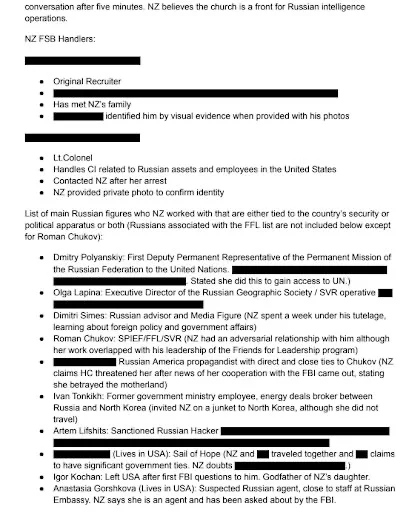

These relationships reflect the integrated nature of her assignments: diplomacy, propaganda, “civil society” outreach, and intelligence work overlapped seamlessly.
A global footprint: Africa, Asia, Middle East, and beyond
Zarubina’s contact list spanned 20+ countries and included foreign academics, youth leaders, media contributors, development consultants, BRICS researchers, and participants in Russian government-sponsored programs.
Among them:
- African media contributors linked to Sputnik Africa
- A Valdai Club–affiliated academic
- A BRICS policy researcher
- Delegates to Russia–Africa youth forums
- A Turkish–Pakistani outreach coordinator
- UN youth diplomats
- Entrepreneurs tied to SPIEF and Davos Russian House initiatives
Many contacts were assessed as “special interest,” meaning they represented potential recruitment or influence targets due to their public roles or future leadership trajectories.
The pattern across all regions was consistent: Russia invested heavily in building friendly personal relationships with young professionals, often before they reached positions of authority. The aim was to shape ideological leanings early, create long-term access points inside foreign institutions, and normalize Russian geopolitical narratives on a global scale.

Diaspora fronts and intelligence cover
Another layer of the network operated through Russian diaspora institutions. Zarubina told investigators that the Russian Orthodox Patriarchate Church in New York acted as a front for intelligence operations and that she visited it with known agent Elena Branson immediately after Branson’s first FBI interview.
The documents describe how the FSB exploited Zarubina’s international work to make her pay her own travel expenses, enabling her to move across continents and attend various gatherings at minimal cost to the state — a tactic that allowed Moscow to scale its outreach far beyond formal diplomatic channels.
A system built to endure
What emerges from the documents is not the story of a lone agent but a global architecture of influence — a system that blends open diplomacy with clandestine operations. Zarubina’s case illustrates how Russian intelligence embeds itself within youth, cultural, and academic networks, using events such as SPIEF, Friends for Leadership gatherings, and Russia–Africa forums as platforms that serve both public and covert purposes.
Investigators found that operatives cultivate foreign individuals for years before activating them, while diaspora institutions quietly provide logistical and informational support. The entire ecosystem merges soft power with targeted intelligence collection.
NV English reached out to Zarubina for comment ahead of her court appearance on Dec.2 2025. Asked about her legal status, she stressed that the proceeding was “not a trial, but a hearing,” adding that it would focus only on procedural details. “We’re only going to discuss specific points,” she said. “No major decision will be issued.”
When asked whether she felt Russia had abandoned her, Zarubina did not hesitate. “No one from any official Russian structure has contacted me,” she said. “I expect nothing from them — and I’m not going to reach out either.”
She described her situation starkly: “In a way, I think I’ve been hung out to dry. No one seems to know what to do with me — or even who I am to them.”
Pressed on how and when her association with the FSB began, Zarubina rejected the idea that she had been formally recruited. “There was no recruitment,” she insisted. “It simply didn’t suit me. I have a very strong, difficult personality that does not allow me to function inside structures like that.”
The military war may be swinging in our favor, but the information war continues.
Just as an army needs soldiers, so does a free society need its journalists to ensure that people have access to honest, trustworthy voices to understand the world around them.
For the past five years, The New Voice of Ukraine has been working tirelessly to push back against Russian narratives and defend democracy. But we cannot do it alone.
Please consider supporting us on Patreon for just $5 a month – your donation does directly to supporting journalists and ensuring that this front of the infowar says solid and defended.
Thank you.
Follow us on Twitter, Facebook and Google News
